Cross-training on the SkiErg is popular in gyms, but does it actually carry over to your stroke? The short answer: yes if you understand what’s actually transferable and what isn’t.
The SkiErg strips away rotation and puts you in a linear plane. The kayak stroke is built on rotation. On paper, that sounds like two completely different movements. But look closer and there’s one principle both machines share, and it’s the principle that makes or breaks your power output on the water: locking the frame.
This is REAL TRANSFER not “it looks similar,” but the underlying mechanic that actually shows up in your boat speed.
Locking the Frame: The Shared Mechanic
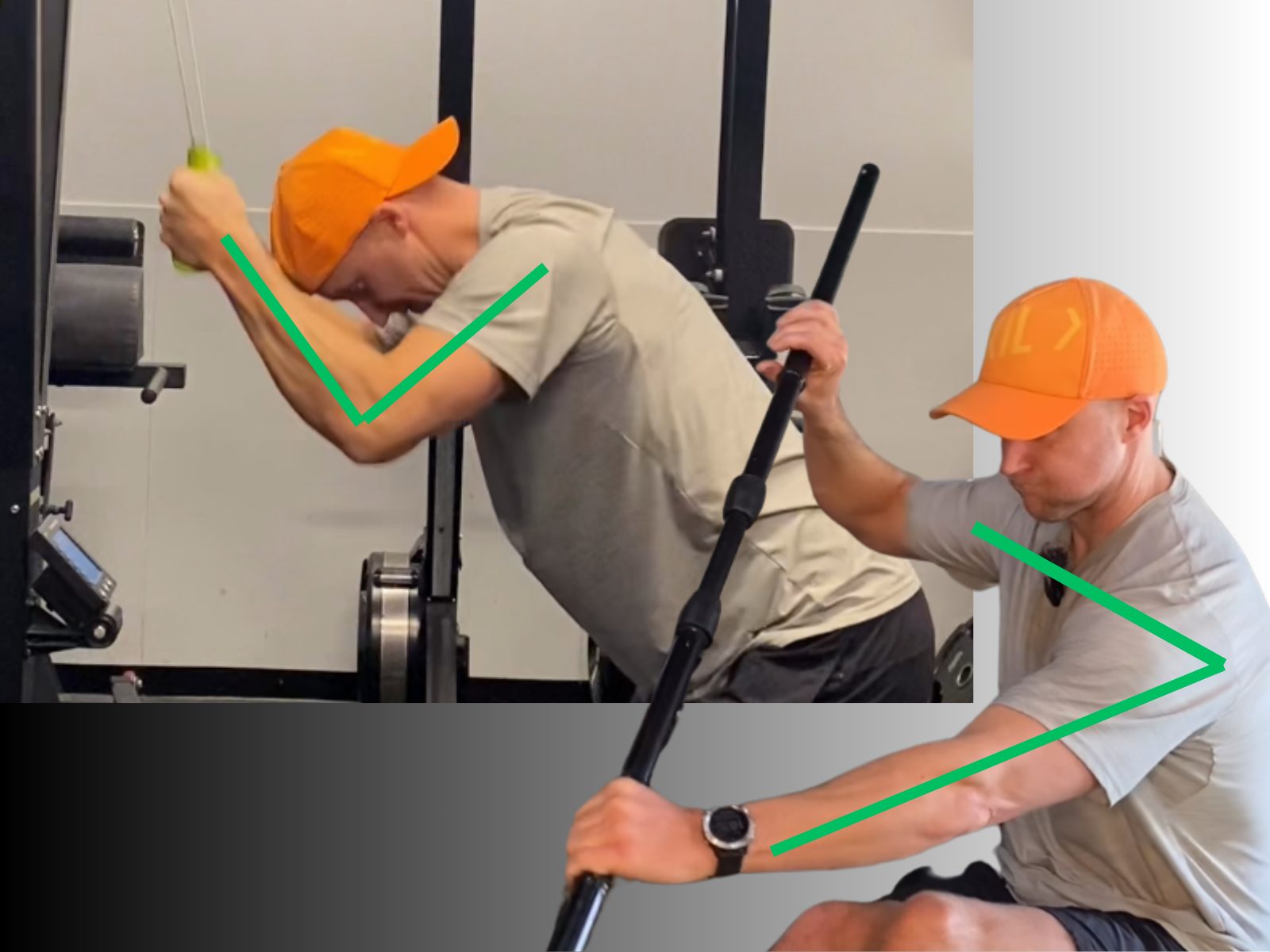
On the kayak, locking the frame means creating a solid, connected structure through your torso so that force generated by your legs and rotation drives straight through the paddle and into the water, instead of leaking out through a collapsing posture.
On the SkiErg, the same idea applies in a linear plane instead of a rotational one. You set up with a slight external rotation to pre-load the lats, a small bend in the elbows, and then flex downward through a locked frame. There’s no leg drive and no rotation on the SkiErg. The force comes from flexion through that locked structure. But the core requirement is identical to the kayak stroke: lock the frame, then drive force through the machine.
That’s the transferable lesson. The plane of motion is different. The mechanism of staying connected through the pull is not.
Effective Range of Motion: Where the Power Actually Lives
Both machines also share a second principle and it’s arguably the more useful one for your stroke: not all of your range of motion is doing useful work.
On the SkiErg, the effective zone runs from the top of the pull down to above hip height. Past that point, you lose leverage. Pulling further back isn’t generating meaningful extra power it’s just extending the stroke into a zone where the machine (and your body) can’t produce much force.
The kayak stroke works exactly the same way. Your effective zone starts at the catch, blade entering the water level with your feet/the front of the boat and ends the moment your blade angle moves toward neutral or negative, roughly in line with your hip. Once you’re pulling behind that point, you’re not adding power. You’re spending time and energy in a stroke phase that isn’t transferring force to the water.
The practical takeaway: the faster you want to go, the shorter and more front-loaded that effective zone becomes. Elite paddlers accentuate this more emphasis on reaching forward and catching early, less time spent finishing the stroke out the back. Spend your time where the leverage is, exit the water promptly, and get the next stroke in on the other side rather than riding out a low-power finish.
Drill: The Stroke Length Stick
If you’re struggling to feel where your effective range actually ends, here’s a simple physical cue you can use on the water or on the erg.
- Take a light stick or dowel and band it across your waist so it sits just behind your hips.
- Paddle (or erg) normally.
- If your stroke runs too far behind your body, your hands or the paddle shaft will contact the stick.
Hitting the stick tells you one of two things is happening:
- You’re relying too much on arm pull instead of rotation and leg drive, or
- You’re simply not exiting the stroke soon enough.
If you’re rotating well and getting good reach up the front, you’ll be able to take a full, powerful stroke without ever touching the stick. The same drill setup works on the SkiErg — start at the top, pull down, and stay inside the zone. Touching the stick means you’ve gone past the point of useful leverage.
Stick Drill
Putting It Together
The SkiErg and the kayak erg aren’t the same movement, one is linear, one is rotational, and only the kayak stroke uses the legs to generate power. But the two principles that actually matter for boat speed are shared by both:
- Lock the frame so force transfers through the machine instead of leaking out through your posture.
- Find your effective range and spend your time there early catch, timely exit.
Used with the right understanding, SkiErg sessions can reinforce these habits. Used without it, they’re just cardio with a rotation-shaped hole in the transfer.
If you want a structured strength and conditioning plan that builds these mechanics into your gym sessions — not generic fitness programming, but sessions built around paddling-specific demands
Check out the Strong Paddler Membership for full access to the exercise library and programming, or explore 1:1 Coaching if you want it built around you.